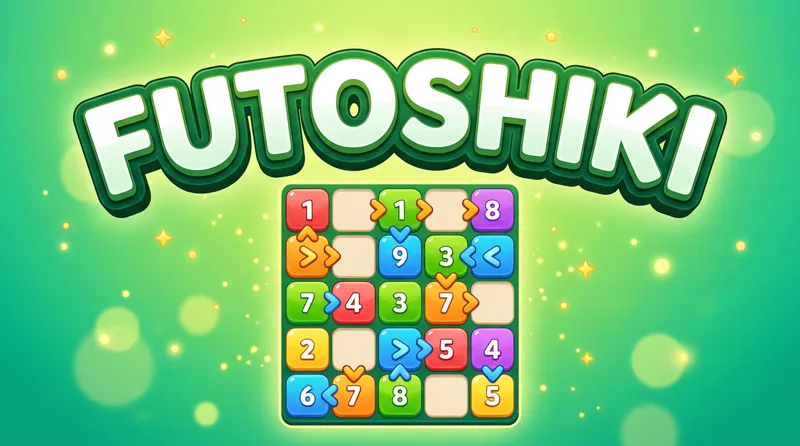
What is Futoshiki?
Futoshiki is a number puzzle built on greater-than and less-than signs. Like sudoku, each row and column uses every number once; unlike sudoku, the clues are small arrows between cells that say which number is bigger.
It is a neat puzzle for anyone who likes sudoku and wants a fresh twist. Play Futoshiki online free here.
How to play Futoshiki
- On an N×N grid, place the numbers 1 to N so none repeats in a row or column.
- Signs between cells show which of the two numbers is bigger.
- Every sign must be obeyed.
- Some puzzles start with a few numbers already given.
Futoshiki tips
Chains reveal the extremes
In a 5×5 grid, a chain a < b < c < d < e can only be 1, 2, 3, 4, 5. Long chains fill themselves.
The biggest number never sits on the small side
A cell that is smaller than a neighbor can never be N, and a cell that is bigger can never be 1. Remove those candidates first.
Mix in sudoku scanning
Once signs narrow a cell, check its row and column. The usual one-per-line rule finishes the job.
Frequently asked questions
What does Futoshiki mean?
Futoshiki is Japanese for not equal, referring to the inequality signs between cells.
Is Futoshiki like sudoku?
Both use no-repeat rows and columns, but Futoshiki has no boxes. The inequality signs are the clues instead.
Which size is best for beginners?
A 4×4 or 5×5 grid is ideal to learn the chains. Larger 7×7 to 9×9 grids are a real challenge.